From Stochastic Parrots to Synthetic Judgment

The Rewiring of Global Private Markets Infrastructure
Atlas Observations - Vol. 1 · April 28, 2026
Introduction
Global capital markets were not built for speed. They were built for control. For decades, financial institutions optimized around human bandwidth: committees, diligence cycles, fragmented data, relationship-driven distribution, and slow settlement layers. The constraint was never the lack of capital. It was the inability to process, structure, and distribute opportunities at scale.
Artificial intelligence enters this system not as a replacement for human judgment, but as a structural shift in how decisions are produced. The prevailing narrative frames modern AI as a “stochastic parrot,” a system that generates outputs without true understanding. The critique is technically correct but economically incomplete. In financial markets, value has never depended on consciousness. It depends on the ability to process uncertainty, compress information, and convert risk into executable investment decisions. Rather than replacing human judgment, AI makes decisions cheaper, faster, and more consistently scalable.
This paper argues that AI should not be evaluated as a flawed human mind but as a new financial primitive: a probabilistic engine for transforming the throughput of decision-making across the entire capital formation process. The implication is architectural. When embedded across the full stack—data ingestion, underwriting, structuring, distribution, monitoring, and settlement—AI collapses the traditional fragmentation of private markets into programmable workflows. What was previously sequential becomes concurrent. What was scarce becomes scalable. What was opaque becomes continuously monitored.
This transition marks the emergence of a new category: the financial machine. Atlas is built on this thesis. Not as an AI tool layered onto finance, but as an infrastructure layer that integrates intelligence into the mechanics of capital movement itself. The objective is simple and structural: shorten the path between local origination and global capital.
From this perspective, the “stochastic parrot” is not a limitation to overcome. It is the starting point of a system that, when properly embedded, evolves into something far more economically powerful: synthetic judgment operating inside a closed-loop capital formation engine. This paper explores that transformation—how probabilistic systems, when combined with financial structure and distribution infrastructure, are redefining the operating model of private markets.
Executive Thesis
Modern AI is criticized because it does not understand the world. The critique is correct. The conclusion usually drawn from it is wrong. Financial markets have never depended fully on consciousness, lived experience, or semantic understanding to create value. They require faster evaluation of uncertainty, better conversion of risk into investable structures, and more efficient distribution of capital.
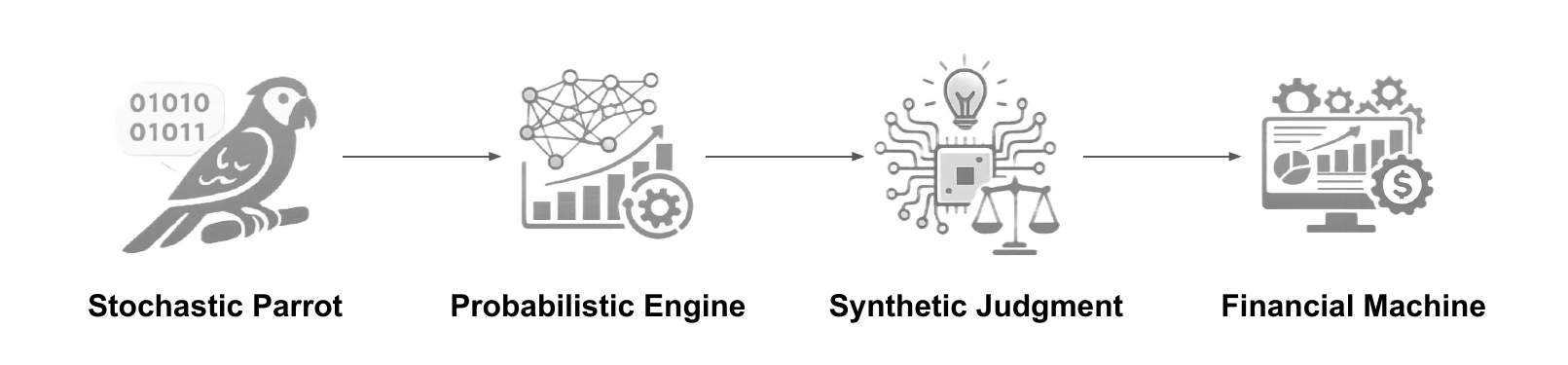
This paper reframes the “stochastic parrot” from a philosophical limitation into a market primitive. A model that statistically recombines patterns without understanding is not a failed human. It is a new kind of financial instrument: a probabilistic compression engine. Its value is not that it thinks. Its value is that it compresses data, time, and ambiguity into decision-ready outputs.
Core thesis: AI will not transform finance because it becomes conscious. It will transform finance because it increases decision throughput, collapses analysis latency, and turns fragmented capital markets into programmable workflows.
Successful institutions will integrate structural safeguards (collateralization, covenants, and tranching) with AI to systematically manage risks the model cannot predict. That is the difference between a model and a machine.
| Claim | Implication for Private Markets |
|---|---|
| The stochastic parrot is not a bug. | Statistical pattern completion is useful when the economic task is probabilistic narrowing, not metaphysical understanding. |
| Decision throughput becomes alpha. | The winning system evaluates more assets, faster, with lower marginal cost and consistent risk discipline. |
| Structure beats prediction at the tail. | AI is weak under regime shifts; tranching, covenants, collateral, excess spread, and monitoring are the real defense. |
| Distribution is the bottleneck. | Capital is abundant, but matching is inefficient. AI-driven distribution is the largest unlock in private markets. |
1. The Stochastic Parrot Was the Opening, Not the Ending
The original parrot metaphor is powerful because it forces a necessary distinction: language generation is not the same as understanding. Alex, the African Grey parrot, could ask “What color am I?” from an embodied position in the world. A large language model can generate the same sentence through statistical likelihood. Same phrase. Different ontology.
For finance, however, the relevant question is not whether the model experiences meaning. It is whether the model can process more signals than a human system, produce usable probability-weighted outputs, and do so at a cost and speed that change the economics of the workflow.
The mistake is evaluating AI as a defective human instead of evaluating it as a superior compression layer.
This paper, therefore, keeps the stochastic parrot at the center of the argument. The term names the limitation. The limitation reveals the function. The function becomes the opportunity. In finance, a system that stitches patterns without understanding can still identify correlations, detect anomalies, classify counterparties, map investor demand, parse legal documents, generate scenarios, and accelerate underwriting.
The parrot does not need to understand credit. It needs to help compress a credit decision. It does not need to feel risk. Furthermore, it needs to help surface where risk may be mispriced. It does not need curiosity. It must expand search.
Exhibit 1: Reframing the Stochastic Parrot
2. Finance Is Not a Search for Truth. It Is a System for Pricing Uncertainty
The financial industry often borrows language from science: models, predictions, signals, and confidence. But markets are not laboratories. They are adversarial systems where value appears when uncertainty is priced, transferred, structured, or distributed better than competitors. This distinction matters. A model does not need to know the true nature of a borrower, asset, or investor. It needs to narrow the range of plausible outcomes enough to support an economic action: reject, approve, price, tranche, hedge, distribute, or monitor.
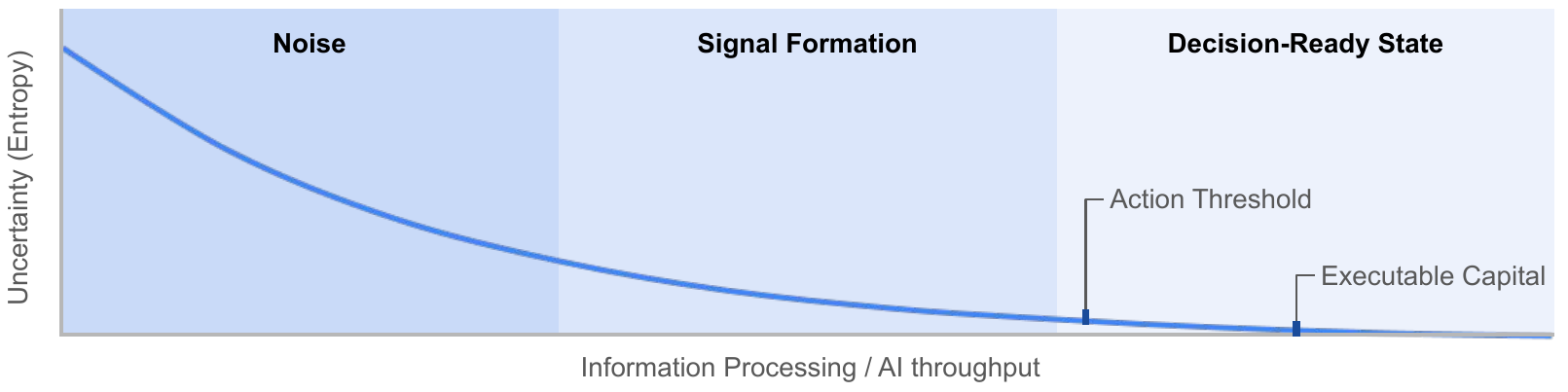
In that sense, AI is not an oracle. It is a narrowing device. It takes high-dimensional uncertainty and produces a smaller, more actionable decision surface. That is why the criticism that it lacks “real understanding” misses the financial point. Finance rarely has perfect understanding. It has probabilities, protections, and execution.
| Human Question | Financial Question |
|---|---|
| Does the model understand the borrower? | Does the model improve the probability-adjusted underwriting decision? |
| Does the model know what risk feels like? | Does the system add structural protections against the risk it may miss? Does it quantify risk mitigation? |
| Can the model reason like a senior banker? | Can it evaluate 1,000 opportunities before the banker sees 10, keeping or even increasing evaluation quality? |
The financial relevance of AI is therefore not cognition. It is entropy reduction. The economic value appears when uncertainty becomes sufficiently compressed to act.
Exhibit 2: From Entropy to Action
3. Decision Throughput Is the New Alpha Primitive
Traditional finance is bandwidth constrained. A team can analyze only so many loan tapes, private credit pools, real estate assets, receivable portfolios, and investor lists. This creates a hidden scarcity: not scarcity of opportunity, but scarcity of evaluation capacity.
AI changes the blocker. It does not merely accelerate the analyst. It changes the unit economics of search. When the marginal cost of evaluating an additional opportunity falls sharply, the firm can search a larger universe, reject more aggressively, and still surface more investable assets. This advantage manifests practically: a traditional analyst might review five opportunities per week, whereas an AI-augmented system could reliably review fifty.
Alpha shifts from unique insights to scale and speed.
This is the decisive shift. A traditional desk may rely on scarce senior attention. An AI-augmented system reallocates senior attention to exception handling, negotiation, structure, and judgment.
The machine handles pattern extraction and first-pass analysis. The human handles non-distributional risk.
| Model | Coverage | Human Role | Alpha Source |
|---|---|---|---|
| Traditional | Low | Primary processor | Individual insight |
| AI-assisted | High | Reviewer and exception handler | Speed and scale |
| Full-stack AI infrastructure | Market level | Architect of risk and distribution | Throughput plus execution |
Decision throughput is not just operational efficiency. It is a new source of market power. The system that evaluates more possible transactions, with consistent risk logic, before competitors even assemble a committee changes the market clearing process.
4. The Tail-Risk Problem: Where the Parrot Breaks
The stochastic parrot is powerful in normal distributions and dangerous at the tail. Because the system compresses patterns from historical data, it is structurally biased toward the known. It can recognize recurrence, but it struggles with rupture. This is not a temporary weakness that disappears with a larger model. It is a property of statistical learning.
In private credit and structured finance, this matters deeply. Severe portfolio losses typically arise from rare discontinuities: fraud, macro shocks, legal failures, or liquidity crises.
Operating principle: AI can accelerate underwriting, but it should never be treated as the final defense against tail risk.
The right response is not to make philosophical claims about artificial general intelligence. The right response is to design financial structures that survive model error. This is where finance has an advantage over pure software: it has centuries of mechanisms for converting uncertainty into bounded exposure.
Subordination, overcollateralization, excess spread, reserve accounts, covenants, eligibility criteria, concentration limits, waterfalls, independent verification, and post-sale monitoring are not administrative details. They are the architecture that allows probabilistic systems to be used safely in real capital markets.
5. Structure Is the Economic Antidote to Model Fragility
Prediction is fragile. Structure is durable. A model can estimate default probability, prepayment behavior, loss severity, asset-liability mismatch, borrower concentration, or collateral volatility. But if the model is wrong, the question becomes: what absorbs the error?
That is the central distinction between a software company making recommendations and a financial infrastructure company manufacturing investable assets. The former optimizes outputs. The latter designs survivability.
AI improves the probability of being right. Structure improves the consequence of being wrong.
This is why the highest-value application of AI in private markets is not autonomous decision-making. It is AI-guided structuring. The model identifies the risk surface; financial engineering determines how that risk is allocated, cushioned, priced, and monitored.
| AI Output | Structural Translation |
|---|---|
| Higher borrower concentration detected | Tighter concentration, larger subordination requirement |
| Volatile payment behavior identified | Dynamic reserve account & harsher trigger mechanics |
| Weak vintage performance surfaced | Eligibility criteria tightened, and older vintages excluded |
| Investor demand clustered around lower volatility | Tranche design adjusted toward senior cash flow stability |
6. Atlas Decision Stack: From Parrot to Financial Machine
Atlas transforms information into capital movement, with Atlas Operating System as the translation of it. It is not a chatbot placed on top of finance. It is an integrated architecture that connects data, models, structure, distribution, monitoring, and settlement.
| Layer | Atlas Operating System | Function |
|---|---|---|
| 1. Data Ingestion | Deal data, loan tapes, investor behavior, monitoring feeds | Turns fragmented raw information into a usable analytical surface |
| 2. Intelligence | Atlas Vector | Compresses credit data into risk scenarios, tranche logic, stress outputs, and underwriting hypotheses |
| 3. Distribution Intelligence | Atlas Prisma | Maps investor appetite, predicts demand, and converts product design into capital targeting |
| 4. Monitoring | Atlas Spectra | Creates post-sale visibility, exception tracking, and trust after distribution |
| 5. Settlement and Treasury | Cross-border rails, fiat, and stablecoin-compatible flows | Reduces funding friction, settlement latency, and pre-funding inefficiencies |
Atlas compresses historically fragmented market functions into unified workflows.
Atlas’s thesis: the next category leader in private markets will not be the best model. It will be the firm that turns models into repeatable market infrastructure.
7. A Deal Walkthrough: Where Value Is Actually Captured
Consider a private credit or asset-backed opportunity originated locally and distributed cross-border. For instance, an SME lending portfolio originated in Brazil that can be assessed, structured into clearly risk-defined tranches, mapped instantly to European institutional investors, and continuously monitored post-sale, sharply reducing execution time and operational friction. The traditional process is sequential: source the asset, clean the data, run diligence, negotiate structure, build materials, search for investors, manage follow-ups, settle funding, and report afterward. Each step has latency. Each handoff creates leakage.
In an integrated system, the workflow becomes concurrent. Vector analyzes the asset pool while Prisma maps potential investor pockets. Structuring adapts not only to the risk profile of the asset but also to observed demand. Spectra defines the monitoring expectations before capital is committed. Settlement rails reduce closing friction. The product is not only manufactured. It is manufactured with distribution and monitoring already embedded.
The economics are clear. Suppose a pool can be originated at a 20 percent annualized yield and distributed at 16 percent. The four-percentage-point spread is not merely a pricing spread. It is compensation for finding the opportunity, underwriting it, transforming risk, matching the investor, and executing the trade. The larger the throughput and the lower the friction, the more scalable that spread becomes.
The spread is not captured by owning the asset. It is captured by owning the workflow.
This is why AI matters more in private markets than in highly liquid public markets. In public markets, information diffuses quickly. In private markets, information is fragmented, trust is local, documents are bespoke, assets are heterogeneous, and distribution is relationship-heavy. AI does not eliminate those frictions. It makes them machine-readable and operationally scalable.
The point is not that each layer is individually novel. The point is that the market has historically separated them across institutions: advisors, arrangers, rating processes, fund platforms, distributors, custodians, payment networks, and reporting providers. The opportunity is architectural compression.
Atlas’s thesis: the next category leader in private markets will not be the best model. It will be the firm that turns models into repeatable market infrastructure.
8. Banks, Asset Managers, and Tokenization: This is why Atlas exists
The incumbent architecture was built for a slower market. Banks own relationships, balance sheets, and regulatory infrastructure, but their systems are organizationally heavy. Asset managers own capital allocation expertise, but they are constrained by mandates, committees, and human diligence capacity. Tokenization alone does not solve distribution.
Contrarian claim: tokenization is not the revolution. Distribution is. Tokenization without underwriting, structure, demand generation, and monitoring is a better wrapper around the same market bottleneck.
The mistake of many digital finance platforms is to treat the asset as the product. In private markets, the asset is only the raw material. The product is the structured, diligenced, distributed, monitored, and settleable investment experience.
| Player | Strength | Structural Weakness |
|---|---|---|
| Banks | Relationships, trust, balance sheet, regulation | Legacy systems, committee latency, balance sheet constraints, high operating cost |
| Asset Managers | Capital allocation, investment discipline, institutional credibility | Limited sourcing bandwidth, slower bespoke analysis, mandate constraints |
| Tokenization Platforms | Digital representation, transferability, programmable ownership | Often weak in origination, underwriting, investor demand, and post-sale trust |
| Full-stack financial machines | Data, AI, structure, distribution, monitoring, settlement | Requires multi-disciplinary execution and trust building across jurisdictions |
The winner is not the institution with the most prestigious humans or the platform with the cleanest token interface. The winner is the architecture that reduces the distance between qualified origination and qualified capital.
9. Synthetic Judgment: A New Primitive for Financial Infrastructure
Synthetic Judgment is the ability to simulate economic decision-making at scale using probabilistic systems without replicating human cognition. It is not artificial wisdom. It is not consciousness. It is not a replacement for fiduciary responsibility. It is a way to generate decision outputs across a much larger opportunity universe than human teams can process alone.
The concept matters because it avoids two bad narratives. The first is naive automation: the idea that AI should fully replace investment judgment. The second is defensive traditionalism: the idea that because AI lacks human understanding, it cannot reshape finance. Both are wrong.
Synthetic Judgment does not replace human judgment. It industrializes the parts of judgment that are repetitive, statistical, and pattern-based.
In practice, Synthetic Judgment creates a new operating model. Humans define the rules, constraints, risk appetite, and structural protections. AI expands the search, surfaces patterns, and proposes scenarios. Financial architecture converts those outputs into products. Monitoring systems detect drift. Settlement rails reduce friction. The result is not a smart model. It is an adaptive capital formation system.
10. The End State: Programmable Private Markets
The current private market stack is fragmented. Origination is local. Diligence is manual. Structuring is bespoke. Distribution is relationship-driven. Settlement is slow. Monitoring is inconsistent. This fragmentation creates return opportunities, but it also caps scale.
The end state is not a fully automated market. It is a more programmable one: a market in which data, risk, investor appetite, documentation, funding, and monitoring are connected through systems rather than coordinated manually through fragmented intermediaries.
In that world, the most valuable firms are not merely originators or distributors. They are market operating systems. They know how to transform local complexity into global investability.
Category definition: Atlas is not building AI for finance. Atlas is building financial infrastructure in which AI is one layer of a broader machine for capital formation.
That distinction is essential. AI alone produces outputs. Infrastructure produces outcomes. The financial machine wins because it controls the path from data to decision to structure to distribution to settlement.
11. Implications for Atlas
For Atlas, the strategic implication is clear: the company should not position itself as another AI-enabled investment platform. That framing is too small and too crowded. The stronger position is that Atlas is building a cross-border private markets infrastructure layer: a system that shortens the path between local origination and global institutional capital.
Vector, Prisma, and Spectra should therefore be presented not as isolated tools, but as components of one capital machine. Vector compresses credit and asset data into structure-ready intelligence. Prisma compresses the investor universe into actionable demand maps. Spectra compresses post-sale opacity into monitoring trust. Together, they solve the core private markets problem: fragmentation. Atlas’s differentiation hinges on operational integration: each component enhances efficiency in the next, creating a reinforcing cycle impossible for fragmented competitors.
The moat is not the model. The moat is the closed loop: data improves analysis, analysis improves structure, structure improves distribution, distribution produces feedback, and feedback improves the next decision.
This is how a stochastic parrot becomes meaningful. The model is not asked to be human. It is embedded inside a system that gives it boundaries, data, feedback, and economic purpose.
12. Conclusion: The Market Does Not Need Conscious Machines
This first article was right to warn against confusing language with understanding. But the deeper lesson is not that AI is weak. The deeper lesson is that AI is different. It does not feel, reason, remember, or care like a human. That is precisely why it can become infrastructure.
Humans are scarce, emotional, embodied, and slow. Machines are scalable, statistical, disembodied, and fast. The future of finance is not about choosing one over the other. It is about assigning each to the layer where it comes with an advantage. Humans manage complexity; machines accelerate repeatable tasks.
The stochastic parrot, when embedded into financial workflows, becomes a powerful component of a financial machine.
Final thesis: We do not need machines to understand the world. We need machines that help price it faster, structure it better, distribute it globally, and monitor it continuously.