From Foundation Models to Financial Cognition

Building the Financial Brain: How Google Cloud Enabled a Cognitive Operating System
Atlas Observations - Vol. 3 · July 31, 2026
Abstract
Large Language Models have transformed natural language understanding, yet global private markets remain largely inaccessible to them: data is fragmented, financial structures are heterogeneous, regulation is jurisdiction-specific, and no unified financial representation exists.
We present the Financial Cognition Engine (FCE), a cognitive architecture for reasoning, opportunity discovery, investment matchmaking, and portfolio intelligence across global private markets.
Built in close collaboration with Google Cloud AI, the engine combines a proprietary Financial Ontology with specialized AI agents, persistent memory, and graph-based knowledge representation, showing how foundation models and cloud-native AI infrastructure enable a new computational layer for private markets.
The production deployment processes more than 100 private-market opportunities per month, monitors portfolios across more than 20 independent investment funds, covers over 500 institutional buy-side organizations, and operates on a proprietary ontology of more than 1,000 structured financial concepts.
We argue this constitutes, to our knowledge, the first cognitive operating system for global private markets.
1. Introduction
Recent advances in foundation models have expanded the capabilities of artificial intelligence. Large Language Models (LLMs) generate high-quality text, summarize complex documents, write software, and solve increasingly sophisticated reasoning tasks. Applying them to global private markets, however, remains an unsolved problem.
Private markets are not short of information. They are characterized by fragmented data sources, heterogeneous financial structures, jurisdiction-specific regulation, contractual complexity, and dense relationships between assets, issuers, investors, intermediaries, and legal entities. Unlike domains where knowledge lives mainly in natural language, financial decision-making depends on structured relationships that no single document expresses.
Consider a structured credit transaction. A language model can identify contractual clauses, summarize legal documentation, or explain a covenant. It cannot, on its own, reason about how that covenant affects recovery expectations, modifies the capital structure, changes the risk profile, or determines investor eligibility under different mandates. Judging whether a Brazilian private credit opportunity satisfies a Japanese institution’s risk, regulatory, currency, and allocation constraints requires a persistent representation of financial knowledge that language alone does not carry. The binding limitation is representation, not intelligence.
Foundation models learn statistical representations of language, while financial markets operate through structured relationships, persistent memory, dynamic constraints, and evolving networks of entities and decisions. Reasoning over such systems calls for different computational primitives than generating coherent text. Human cognition offers a useful analogy: the brain does not reason exclusively through language; it relies on an internal model of the world that integrates memory, perception, causal relationships, planning, and experience into a coherent representation of reality.
Language is only one interface to that internal model, and financial intelligence requires an equivalent abstraction: an intermediate cognitive layer that represents financial concepts, preserves institutional memory, orchestrates specialized reasoning, and improves through operational feedback.
This paper introduces the Financial Cognition Engine (FCE), a cognitive architecture that bridges foundation models and real-world financial infrastructure. It combines a proprietary Financial Ontology, persistent financial memory, distributed reasoning across specialized AI agents, and continuous learning into a system that supports opportunity discovery, investment matchmaking, portfolio intelligence, and financial decision-making across global private markets.
Foundation models are one component within this architecture. Structured knowledge, domain-specific reasoning, memory, orchestration, and feedback loops supply the capabilities that language modeling alone cannot. The conceptual architecture is illustrated in Figure 1.
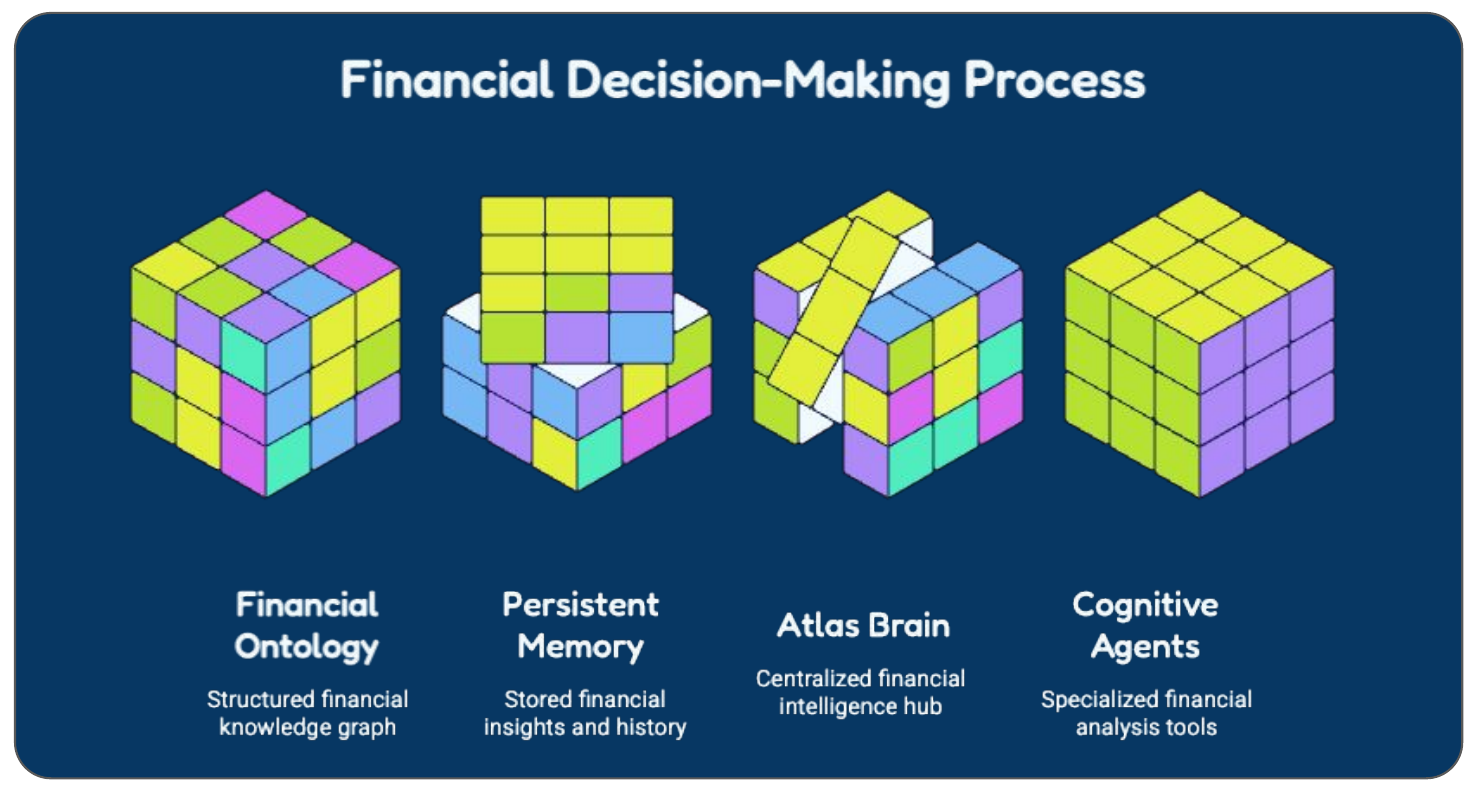
Figure 1. High-level architecture of the Financial Cognition Engine
2. The Missing Layer
The rapid adoption of foundation models has led to a common architectural pattern across most AI applications in financial services. Although implementations vary, the underlying computational paradigm remains remarkably consistent:
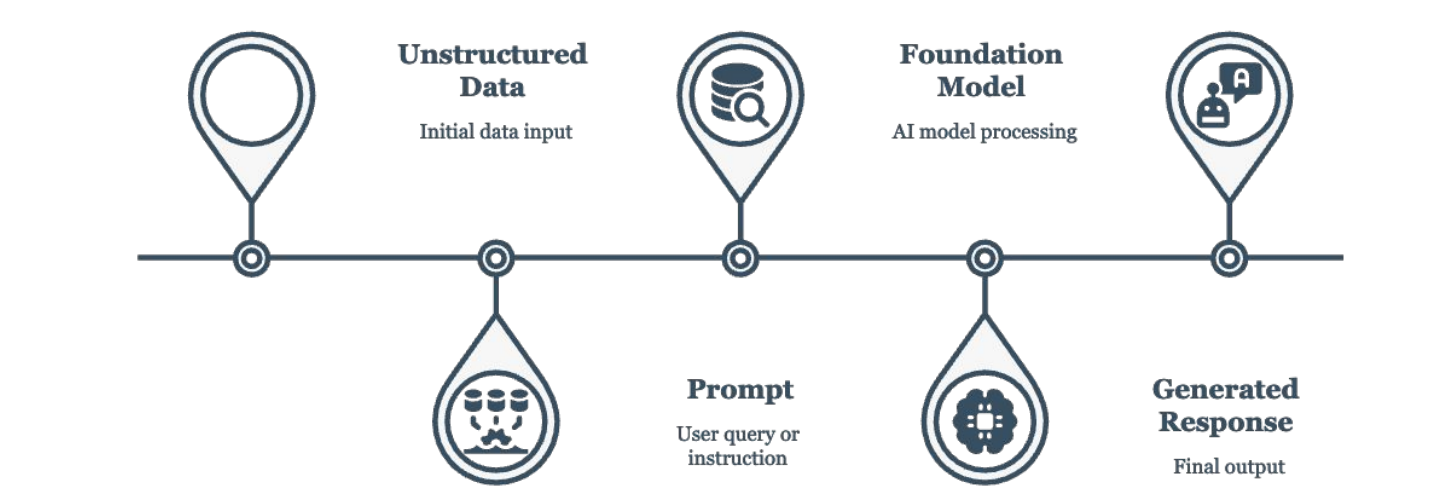
This architecture has proven effective for language understanding, document summarization, information retrieval, question answering, and code generation. It reduces the cost of working with unstructured information and gives complex workflows a natural language interface.
The paradigm reaches its limits in domains where decisions emerge from persistent, structured relationships between entities, events, constraints, and historical context. Global private markets are such a domain: a transaction is a dynamic system of issuers, investors, legal structures, guarantees, regulatory requirements, cash flows, jurisdictions, counterparties, historical negotiations, and portfolio exposures interacting over time, with dependencies that reach far beyond the text of any individual document.
Prompting cannot faithfully carry this complexity, because each interaction with a foundation model is transient. Modern models reason well within a context window, yet they do not natively maintain persistent domain knowledge, accumulate institutional experience, coordinate specialized reasoning, or refine their internal representation of a financial ecosystem through operational feedback.
Many current AI systems therefore rebuild context that should be part of an evolving cognitive model. This architectural gap is, in our view, the main obstacle to foundation models operating as reliable financial intelligence systems, and we address it with the Financial Cognition Layer, the abstraction that the Financial Cognition Engine implements.
The layer augments foundation models with the capabilities that domain-specific cognition requires, functioning as an intermediate abstraction between general-purpose intelligence and financial applications. It is composed of six integrated capabilities:
Knowledge Representation, modeling financial concepts, entities, relationships, and constraints through a structured ontology rather than isolated documents.
Persistent Financial Memory, accumulating institutional knowledge across transactions, investors, portfolios, and operational experience.
Distributed Reasoning, in which specialized AI agents solve different classes of financial problems.
Cognitive Orchestration, coordinating agents, managing context propagation, resolving conflicts, and setting execution strategy.
Continuous Learning, feeding operational outcomes back into memory and knowledge representation.
Contextual Financial Intelligence, bringing historical, operational, regulatory, and transactional context into every reasoning process.
Together these components turn a foundation model from an isolated inference engine into one participant in a cognitive architecture built for persistent financial intelligence: a system that understands a financial ecosystem, accumulates experience, coordinates specialized expertise, and improves as new decisions are made.
In this sense, the Financial Cognition Layer functions as a new computational abstraction between foundation models and domain-specific infrastructure, supplying the cognitive capabilities AI systems need to operate reliably in complex financial environments.
3. Financial Ontology
One of the central contributions of the Financial Cognition Engine is its Financial Ontology, a structured semantic representation of the entities, relationships, constraints, and concepts that define global private markets.
Foundation models operate over statistical representations of text, while financial reasoning depends on the economic and legal relationships connecting market participants, assets, contractual obligations, and investment structures. Those relationships are rarely explicit in documents; they must be inferred, contextualized, and integrated into a coherent representation of the financial system. Where most AI systems treat documents as the primary unit of reasoning, the Financial Cognition Engine reasons over relationships, and that choice shapes how financial intelligence is constructed.
Instead of asking what a document says, the system asks what the information represents within the financial ecosystem and how it affects related entities and future decisions.
The Atlas Financial Ontology currently models more than 1,000 structured financial entities, attributes, and semantic relationships: assets, issuers, investment vehicles, institutional investors, guarantees, contractual clauses, cash flow structures, jurisdictions, legal entities, counterparties, covenants, portfolio characteristics, risk metrics, and regulatory constraints, among other domain concepts. These elements are not isolated records; they form an interconnected financial knowledge network that supports reasoning across several dimensions at once. New information is interpreted semantically as it arrives: documents become financial facts, and facts become part of an evolving model of the market.
Consider the contractual statement “The transaction includes a fiduciary assignment of receivables.” For a conventional language model this is a sentence to summarize. Within the Financial Ontology it is a structured financial event: it establishes a new collateral relationship, modifies the priority of claims in the capital structure, alters recovery scenarios under default, influences Loss Given Default assumptions, changes the eligibility profile for categories of institutional investors, and may introduce regulatory or mandate-specific constraints depending on jurisdiction. The financial consequences of the document become computable.
This semantic transformation lets downstream components reason over economic meaning instead of textual content, and it is the foundation on which portfolio intelligence, investor matching, opportunity discovery, and autonomous financial reasoning operate consistently.
The Financial Ontology is therefore more than a knowledge repository: it is the semantic infrastructure through which every cognitive component of the Financial Cognition Engine shares one representation of financial reality. Without it, each interaction with a foundation model would rebuild financial context from unstructured language; with it, financial knowledge stays persistent, interconnected, reusable, and enriched by every new transaction the system processes.
Language models may understand financial terminology; financial cognition requires a formal representation of financial meaning. The Financial Ontology provides that representation, and Atlas’ production implementation is shown in Figure 2.

Figure 2. Atlas Ontology World.
4. Atlas Brain
The Financial Cognition Engine consists of multiple specialized cognitive components rather than a single monolithic model, each optimized for a distinct class of financial reasoning tasks. Specialization improves accuracy and scalability, and it raises a systems question: how do independent components operate as one coherent intelligence? The Atlas Brain exists to answer it.
The Atlas Brain is the cognitive coordination layer of the engine. It maintains continuity across reasoning processes, preserves institutional knowledge, coordinates the specialized agents, and ensures that financial decisions emerge from a consistent, evolving representation of the market. It performs six core functions:
Persistent Financial Memory keeps knowledge from previous transactions, negotiations, portfolio analyses, and investor interactions available for future reasoning, so understanding is accumulated instead of reconstructed.
Context Consolidation aggregates the information produced by collaborating agents into a shared representation of the transaction at hand.
Cognitive Orchestration decides which agents participate in each workflow, manages the exchange of information between them, and coordinates execution order.
Conflict Resolution reconciles complementary analyses, overlapping conclusions, and competing hypotheses into a coherent decision process while preserving traceability.
Knowledge Accumulation extracts reusable knowledge from completed workflows, enriching the Financial Ontology and the persistent memory layer.
Incremental Cognitive Growth turns every processed opportunity, monitored portfolio, completed transaction, and investor interaction into a broader internal understanding of financial markets.
This differs from conventional multi-agent systems, where orchestration is largely procedural: agents execute predefined task sequences through temporary contexts, and once execution completes, much of the acquired knowledge is discarded. The Atlas Brain treats every interaction as an opportunity to expand a persistent cognitive model of the financial ecosystem, so knowledge compounds over time.
From a systems perspective, the Atlas Brain is the orchestration layer of the Financial Cognition Engine, integrating semantic knowledge, persistent memory, and specialized reasoning into one framework for long-lived financial intelligence. A biological analogy for this architecture is illustrated in Figure 3.
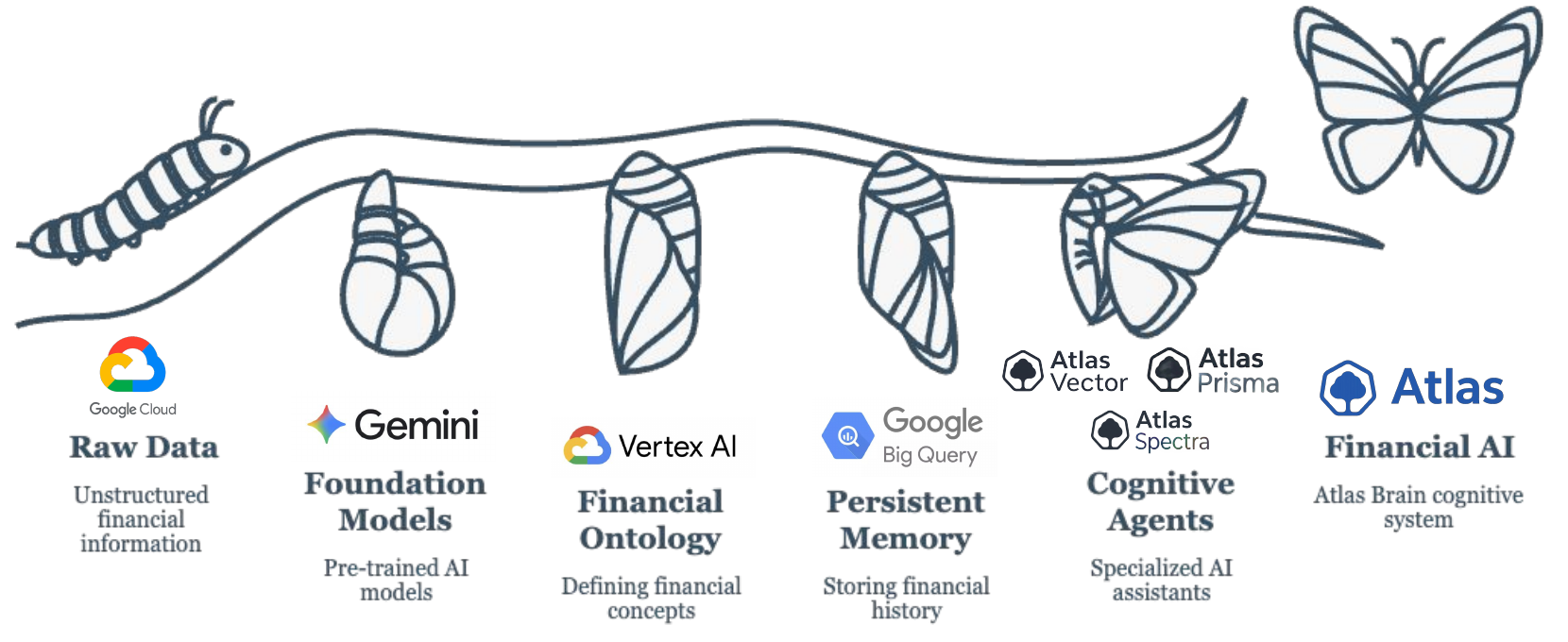
Figure 3. COS - Cognitive Operating System
5. Specialized Financial Agents
General intelligence alone cannot cover the reasoning tasks that span the lifecycle of a private market transaction. Opportunity sourcing, investor discovery, portfolio surveillance, transaction structuring, and orchestration each require distinct knowledge, specialized reasoning strategies, and access to different subsets of financial information, so the Financial Cognition Engine adopts a distributed architecture of specialized financial agents.
Each agent is built around a well-defined domain of expertise and operates over the shared Financial Ontology, the Persistent Financial Memory, and the Atlas Brain orchestration layer. Agents reason independently while contributing to one evolving representation of financial markets.
The current production implementation comprises more than twenty specialized agents. The three principal agents are presented below, followed by the Atlas Brain, the orchestration layer that coordinates them.
Atlas Vector: Opportunity Discovery & Modeling Engine
The investment industry still relies on manual sourcing driven by meetings, email exchanges, spreadsheets, presentations, legal documentation, and fragmented market intelligence, so valuable opportunities stay hidden in unstructured information long before they become structured transactions.
Vector addresses this as an Opportunity Discovery Engine that transforms heterogeneous information into structured investment opportunities. It ingests meetings, presentations, financial documentation, legal contracts, internal communications, and market intelligence; using the Financial Ontology as its semantic foundation, it identifies entities, relationships, transaction characteristics, and potential investment structures, converting raw information into standardized opportunities that downstream components can evaluate.
The production deployment currently processes more than 100 private market opportunities every month, expanding the opportunity pipeline while reducing the operational effort required for origination. See Figure 4 (next page).

Figure 4. Atlas Vector in place.
Within the Financial Cognition Engine, Vector functions as the primary interface between the external financial environment and the internal cognitive system, transforming market information into structured financial knowledge. Atlas Vector’s Ontology is represented in Figure 5.
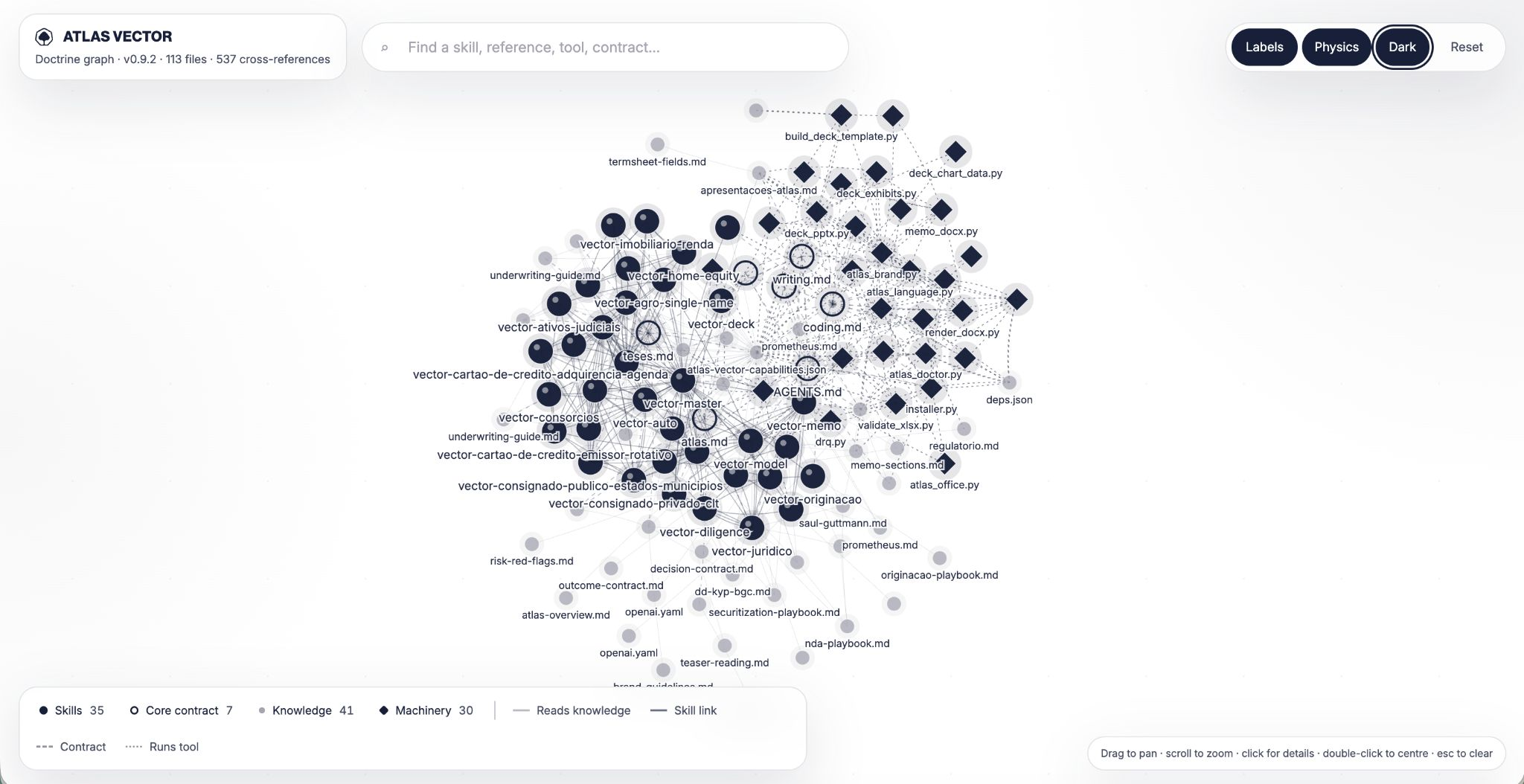
Figure 5. Atlas Vector Ontology.
Atlas Prisma: Global Investor Intelligence Engine
Identifying the right institutional investor for a private market opportunity is one of the most complex matching problems in finance. Decisions depend on far more than asset characteristics: institutional mandates, regulatory restrictions, geography, currency exposure, concentration limits, ticket size, liquidity preferences, sector expertise, and historical allocation behavior all determine whether an opportunity suits a particular investor.
Prisma models this multidimensional decision space as a Global Investor Intelligence Engine, maintaining an evolving representation of institutional capital across global private markets.
The current production deployment models more than 500 institutional buy-side organizations, with structured information on mandates, preferred asset classes, geographical focus, regulatory constraints, ticket sizes, portfolio strategies, and historical allocation behavior. Prisma performs semantic matchmaking between opportunities and institutional demand, identifying investors by structural compatibility instead of simple categorical filters, and it refines its representation of market demand as transactions complete and interactions accumulate.
Atlas Spectra: Continuous Portfolio Intelligence
Traditional portfolio monitoring is largely retrospective: systems consolidate positions, calculate performance metrics, and generate periodic reports from historical information. Spectra operates instead as Continuous Portfolio Intelligence, monitoring financial assets after the investment decision so that portfolio intelligence evolves alongside the underlying investments.
The platform currently monitors portfolios belonging to more than 20 independent third-party investment funds, so its capabilities extend beyond assets originated within the Atlas ecosystem. By integrating new financial events into the Financial Cognition Engine as they occur, Spectra turns portfolio monitoring from a periodic reporting activity into an always-on cognitive process. See Atlas Spectra in Figure 6.
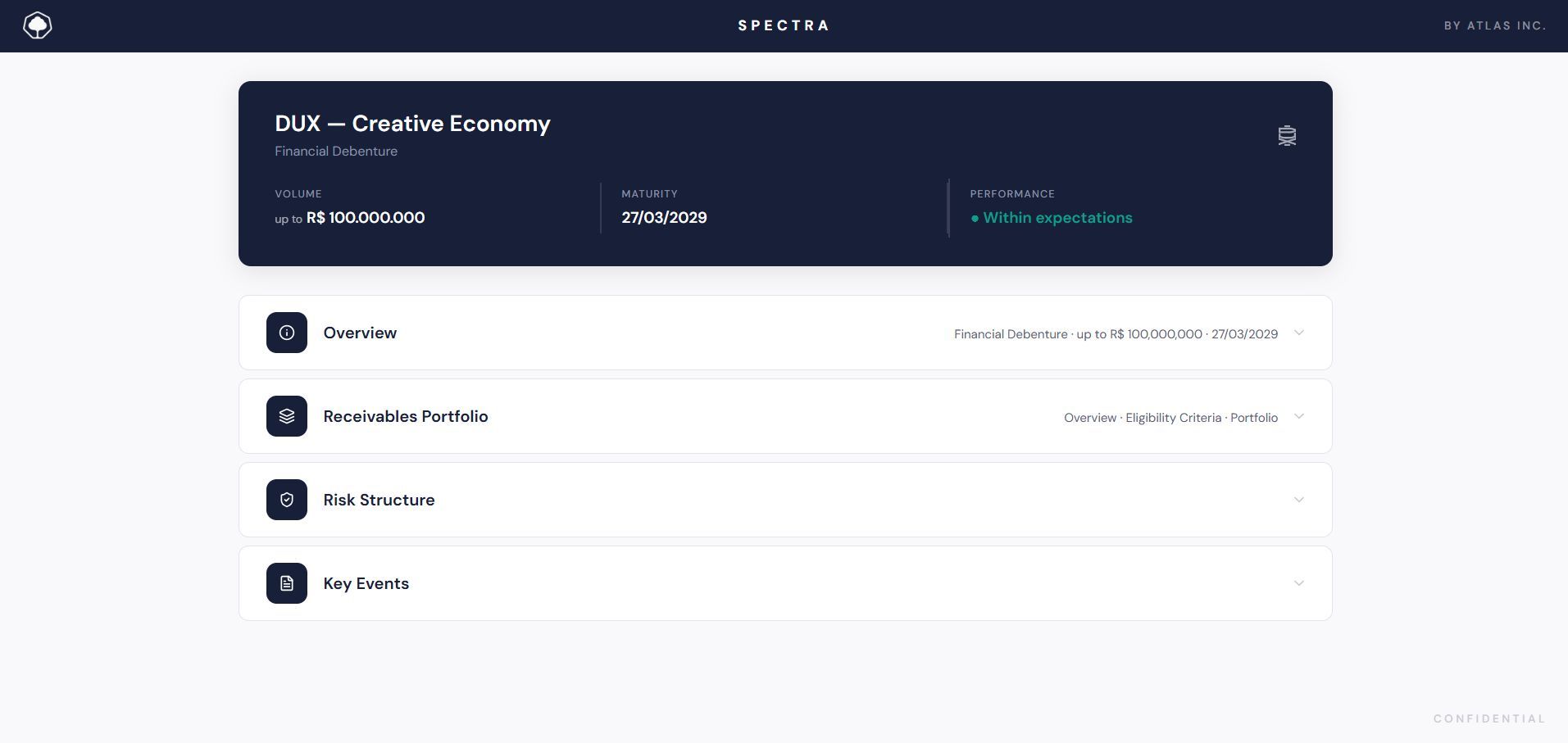
Figure 6. Atlas Spectra running for a real deal: DUX.
Atlas Brain - Cognitive Orchestration Engine
Complex financial reasoning requires coordination across the specialized agents, and the Atlas Brain provides it, operating as the orchestration layer described in Section 4. For each reasoning process it selects the participating agents, retrieves the relevant context from the Persistent Financial Memory, coordinates the exchange of information, validates intermediate outputs, and determines when human intervention is required before a financial decision is finalized.
Because orchestration is dynamic rather than a fixed pipeline, the engine adapts its reasoning strategy to the complexity and context of each financial problem, and the cognitive agents behave as one financial intelligence system instead of isolated AI applications.
Collective Intelligence
Individually, each agent addresses one category of financial reasoning; collectively they form an interconnected cognitive ecosystem. Vector expands the universe of investment opportunities, Prisma identifies the investors most compatible with each one, Spectra monitors investments through their lifecycle as market conditions evolve, and the Atlas Brain keeps knowledge, memory, and reasoning synchronized across the architecture.
Every processed opportunity, investor interaction, portfolio event, and financial decision feeds this loop, strengthening the system as a whole: fragmented market information becomes persistent financial intelligence.
6. Financial Knowledge Network
The long-term value of an intelligent financial system depends on its ability to remember, connect, and improve as much as on its ability to reason.
Section 2 described why stateless interaction caps what foundation models can do in finance. The Financial Cognition Engine is built the opposite way: every interaction contributes to an evolving representation of the financial ecosystem: opportunities, investor conversations, portfolio events, transaction outcomes, and operational workflows all enrich its internal knowledge.
This persistent intelligence is built upon Google Cloud’s AI and data infrastructure. Foundation reasoning is provided by Gemini through Vertex AI, while long-term knowledge is maintained across structured and unstructured storage layers, including BigQuery, AlloyDB, Vertex AI Vector Search, and the Atlas Financial Ontology.
Storing information is only part of the problem; the engine also preserves decisions. Every evaluated opportunity generates a structured decision graph capturing the outcome and the financial reasoning that produced it. Each decision becomes a persistent node connected to assets, issuers, investors, transaction structures, jurisdictions, portfolio exposures, mandates, regulatory constraints, execution history, and subsequent performance. These interconnected decisions form an expanding Financial Decision Graph that lets the system reason from accumulated institutional experience as well as from documents. Knowledge becomes a living network of financial relationships, and it enables continuous learning.
Every cognitive component improves the others: knowledge extracted by Vector expands the Financial Ontology, a richer ontology improves Prisma’s investor matching, investor interactions enrich the Financial Decision Graph, portfolio observations from Spectra validate previous assumptions, and operational outcomes refine the Atlas Brain’s future orchestration decisions. Experience acquired in one domain propagates across the entire system.
The result is a self-reinforcing cognitive network in which intelligence compounds over time. The engine’s capability grows less by adding data or swapping in larger foundation models than by accumulating structured knowledge, persistent memory, and interconnected decisions. We believe this feedback architecture is a defining characteristic of Financial Cognition.
7. Production Deployment: Financial Cognition at Scale on Google Cloud
The Financial Cognition Engine could not have been built with foundation models alone. It required enterprise-grade AI infrastructure capable of orchestrating multiple reasoning agents, persistent memory, structured knowledge, secure deployment, and production-scale inference. Google Cloud provided the technological foundation that allowed Atlas to move from isolated AI models to a continuously operating cognitive financial system: every layer of the architecture, from foundation models and specialized agents to memory, monitoring, and security, runs on Google Cloud services working as one integrated platform.
The current production deployment demonstrates that this architecture is capable of supporting real-world financial workflows across opportunity origination, investor intelligence, portfolio monitoring, and cognitive orchestration.
Current production metrics include:
| Production Metric | Current Deployment |
|---|---|
| Opportunities processed monthly (Atlas Vector) | > 100 |
| Institutional Buy-Side Organizations (Atlas Prisma) | > 500 |
| Third-party investment funds monitored (Atlas Spectra) | > 20 |
| Financial concepts represented in the Ontology | > 1000 |
| Specialized Cognitive Agents | > 20 |
| Cloud Platform | Google Cloud |
These metrics describe throughput. The more important result is qualitative: Google Cloud lets Atlas operate the Financial Cognition Engine as an evolving production system, and the next table summarizes how.
Google Cloud as the Cognitive Infrastructure
The table maps each major cognitive capability to the Google Cloud technology that enables it.
| Atlas Capability | Google Cloud Technology | Operational Contribution |
|---|---|---|
| Foundation reasoning | Gemini (Vertex AI) | General-purpose reasoning across financial workflows. |
| Investor Intelligence (Prisma) | Gemini Flash | Low-latency semantic reasoning for investor profiling and opportunity matchmaking. |
| AI-assisted Software Engineering | Gemini Code Assist | Accelerates software development, code review, and implementation of cognitive components. |
| Cognitive Infrastructure | Cloud Run | Automatic horizontal scaling of cognitive services according to operational demand. |
| Financial Knowledge Analytics | BigQuery | Consolidates operational KPIs, analytical workloads, and feeds Atlas Brain with structured intelligence. |
| Operational Monitoring | Cloud Monitoring | Real-time monitoring of cognitive services, infrastructure health, and operational incidents. |
| Security Protection | Cloud Armor | Protection against external attacks and secure exposure of financial services. |
| Security Operations | Security Command Center | Continuous security posture management, threat detection, and centralized security monitoring. |
From Cloud Infrastructure to Financial Cognition
An important observation from the production deployment is that the value of Google Cloud comes from the integration of these services as much as from any individual capability; together they form the technological base on which the Financial Cognition Engine evolves.
Comparative Architecture:
The practical impact of this architecture becomes evident when comparing a conventional AI implementation with the Google Cloud–powered Financial Cognition Engine.
| Capability | Conventional AI Stack | Financial Cognition Engine on Google Cloud |
|---|---|---|
| Opportunity Processing | Manual workflows with isolated AI assistance | Continuous processing of 100+ opportunities/month through Vector |
| Investor Intelligence | Static CRM and manual segmentation | Semantic modeling of 500+ institutional buy-side organizations using Gemini Flash |
| Portfolio Monitoring | Periodic reporting | Continuous monitoring of 20+ independent investment funds through Spectra |
| Knowledge Representation | Documents and prompts | Financial Ontology with 1,000+ structured financial concepts |
| Infrastructure Scaling | Manual provisioning | Automatic scaling through Cloud Run |
| AI Development | Traditional software engineering | AI-assisted development using Gemini Code Assist |
| Operational Intelligence | Fragmented dashboards | Unified analytical layer powered by BigQuery feeding Atlas Brain |
| Security Operations | Independent security tooling | Integrated protection through Cloud Armor and Security Command Center |
| System Evolution | Episodic improvements | Continuous cognitive evolution driven by production feedback |
Beyond Infrastructure
The production deployment shows Google Cloud operating as part of the cognitive architecture itself, beyond its role as execution platform: elastic execution lets specialized agents scale dynamically, Gemini underpins generalized financial reasoning, BigQuery consolidates operational knowledge into an evolving analytical layer, and Cloud Monitoring, Security Command Center, and Cloud Armor keep production-grade operation manageable.
The Financial Cognition Engine therefore treats cloud services as one computational fabric in which AI, data, security, observability, and scalable execution jointly sustain persistent financial intelligence.
Operational Results
The metrics above describe scale. Their effect on daily work is easier to see in hours: across the five stages of a typical transaction, Vector reduces hands-on analyst effort from approximately 25 to 10 hours, a reduction of roughly 60% (Figure 7). The largest gains appear in financial modeling and committee materials, where structured knowledge removes most of the manual assembly.
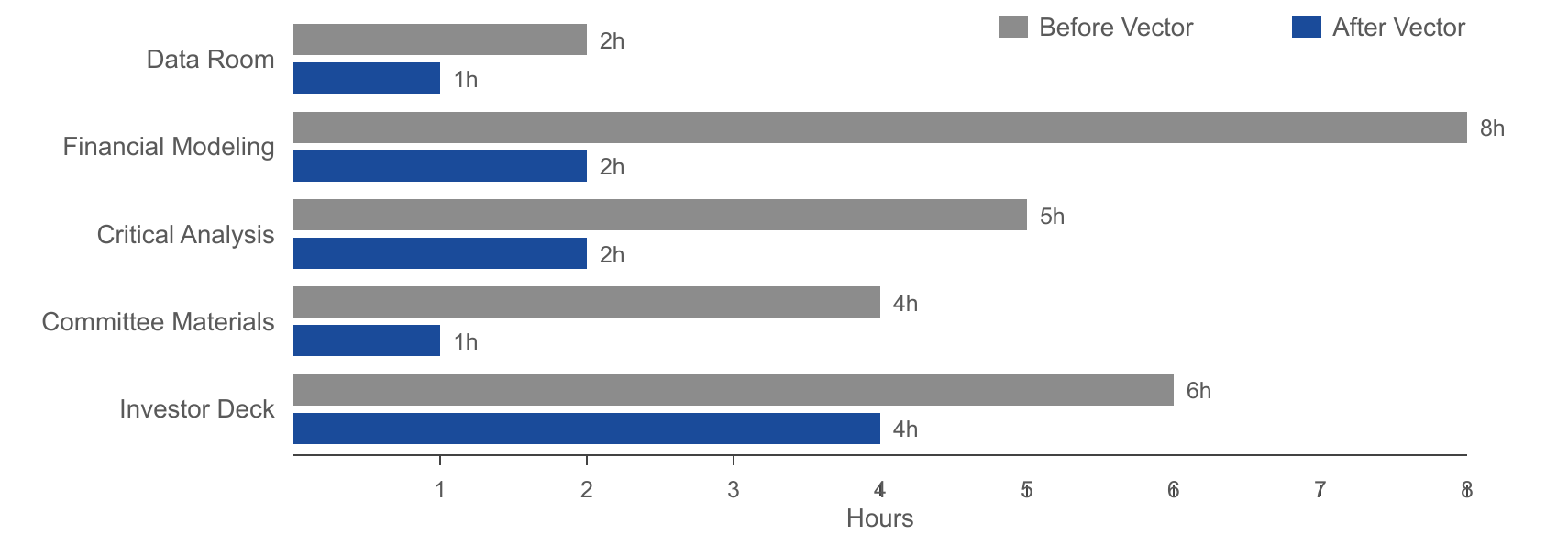
Figure 7. Analyst hours per transaction stage, before and after Vector.
| Transaction stage | Before Vector | After Vector |
|---|---|---|
| Data Room | 2h | 1h |
| Financial Modeling | 8h | 2h |
| Critical Analysis | 5h | 2h |
| Committee Materials | 4h | 1h |
| Investor Deck | 6h | 4h |
Security follows the same production discipline. Deal documents enter through a local-first intake: files remain on the analyst’s device until explicitly submitted, and from that point on they are processed entirely inside Atlas’s Google Cloud perimeter, protected by Cloud Armor and monitored through Security Command Center.
The ontology accumulates alongside these gains. Every processed transaction leaves behind structured entities, relationships, and constraints, so the concept base reported above forms a growing operational asset: each new deal consumes the semantic base and extends it for the next one.
8. Future Research
The Financial Cognition Engine was developed for global private markets, and we believe its architectural principles extend well beyond finance. Many industries face the same limitation: foundation models reason over language while lacking the persistent domain knowledge, structured semantic representations, long-term memory, and specialized workflows that complex decision-making requires.
We hypothesize that the framework proposed here generalizes to other knowledge-intensive domains, including healthcare, legal services, industrial operations, defense, supply chains, and scientific research: the core architecture stays unchanged while the ontology, the specialized agents, and the decision models evolve to fit each ecosystem.
Financial Cognition would then be the first implementation of a broader computational paradigm, in which future AI systems combine general-purpose intelligence with domain-specific cognitive layers: Domain Cognition Engines that turn general intelligence into persistent, specialized intelligence for complex real-world systems. This direction shifts the focus from scaling models alone to designing cognitive architectures in which knowledge, memory, context, and accumulated experience matter as much as reasoning itself.
Next Chapters
The research lines below extend the Financial Cognition Engine along the Google Cloud stack that already runs it. Each is a candidate subject for a future volume of Atlas Observations.
Reinforcement learning from financial outcomes. Committee decisions, allocation results, and realized portfolio performance form a reward signal; Vertex AI training and tuning services would let orchestration policies learn from it.
Multi-agent negotiation. Structuring a transaction involves parties with partially opposed interests. Agent-to-agent protocols on Vertex AI Agent Builder would let specialized agents represent those positions and search for terms that clear.
Cross-border regulatory reasoning. Long-context Gemini models make it feasible to reason over several regulatory regimes at once, a requirement for international distribution of Brazilian structured credit.
Autonomous portfolio optimization. Monitoring events generated by Spectra and consolidated in BigQuery provide the data for allocation recommendations that adjust as portfolios evolve.
Evaluation benchmarks for financial cognition. Public benchmarks measure general reasoning; financial cognition as defined in this paper still lacks one. Vertex AI evaluation tooling gives us the base to build and publish it.
Just as cloud computing enabled a new generation of enterprise software, AI-native cloud infrastructure is now enabling a new generation of cognitive financial systems. The collaboration between Atlas and Google Cloud illustrates how foundation models become substantially more capable when combined with domain-specific knowledge, persistent reasoning, and production-grade orchestration.