Distribution Is the Bottleneck

What prevents qualified private-credit assets from reaching qualified capital?
Atlas Observations - Vol. 2 · July 08, 2026
Abstract
Private credit no longer lacks capital or assets. Its harder constraint is distribution: the work required to make a local asset readable, ownable, and executable for a specific buyer and channel. This paper argues that the scarce layer is qualified matching, the operating path from origination signal to buyer fit, structure, and monitoring. Atlas’s opportunity is to own that workflow, and Prisma is the system that makes buyer constraints, appetite, evidence, and outcomes usable before a deal becomes marketing.
Introduction
Private credit is usually described in the language of scale: trillions in assets, record fundraises, mega-funds, and banks retreating from balance-sheet lending. That story is true. It also sits too far above the work that decides whether a deal clears.
Private credit markets have plenty of capital and plenty of assets. A borrower may be known locally, the receivables pool performing. A lender may have the relationships; a buyer, the mandate; and the capital. This paper asks a narrower question: if capital and assets both exist, what still prevents a qualified private-credit deal from clearing a qualified buyer?
The answer is distribution, understood as translation work that starts long before a sales call: turning local credit knowledge into an institutional file and operating path that a specific buyer can underwrite, approve, and monitor, whether that buyer is an institution, an advisor, or a platform.
That translation layer has to resolve mandate fit, diligence, and channel approval before capital can move, then keep the position serviceable and monitorable after it does.
Capital Has Formed
Institutional investors already understand private credit, and demand is no longer the open question. AIMA/ACC estimates global private credit AUM at US$3.5 trillion, with institutional investors accounting for 76% of AUM. The harder test now sits at deal level: whether a specific opportunity can clear a specific buyer’s gates.
Demand is moving downstream as well. The 60/40 portfolio is losing its grip fastest among younger investors, and Merrill Lynch expects roughly US$124 trillion to change hands by 2048. Bank of America’s research shows the receiving generation already holds about three times the alternatives exposure of the one handing it down.
That shift raises the standard for the layer between asset and capital.
Scarcity now sits in cleared access: a specific transaction, for a specific buyer, through a specific channel, with enough structure and data to be approved, booked, distributed, and monitored.
The U.S. Makes the Channel Visible
The U.S. private-credit market shows the point most clearly. At fund level, the language is institutional. At asset level, the business is mid-market. EY puts the median U.S. private-credit deal in 2024 at roughly US$87 million, and about 70% of providers say borrowers come to them because they are too small for bank syndication. Those borrowers pay for certainty, speed, flexible structure, and a lender who can hold the relationship to maturity.
That creates the same problem Atlas sees cross-border. Once size pushes these borrowers out of syndication, the premium lives in the parts of the market that resist scale: local origination, custom structuring, borrower knowledge, servicing discipline, and channel trust. A relationship cannot be syndicated. A custom covenant cannot be mass-produced. A loan that works on credit still has to reach the party that can actually place or hold it.
In the U.S., that party is often the financial advisor. Retail and high-net-worth capital usually reaches private credit through an RIA, a broker-dealer, a multi-family office, or a platform, typically inside a feeder or registered vehicle. The advisor decides what the client sees, what fits the plan, and what actually gets bought.
That gate is also moving. The channel is consolidating into fewer, larger firms and shifting from commissions toward asset-based fees, which Cerulli estimates at around 72% of advisor revenue in 2024, on track for 78% by 2026. A fee-based advisor has no commission reason to avoid an alternative and a real reason to seek assets that justify the fee.
The advisor relationship also runs upstream. The same RIA or multi-family office that places product often sits close to clients who own businesses, real estate, and private assets — clients with financing needs of their own. A business owner who needs a receivables facility, a portfolio company that needs growth debt, a real-estate operator who needs a bridge: each can become a signal the advisor sees early.
That signal still has to be treated carefully. Advisor-referred flow can create conflicts around compensation, suitability, allocation, and disclosure, especially if the same network later places the exposure. It also arrives as raw relationship intelligence, before any credit screening has happened. Every referred deal has to clear the same validation bar as any other asset, otherwise the channel adds noise faster than it adds capacity.
The broader pattern is the point: mature private-credit markets expose the same bottleneck Atlas is built around. Scarcity sits in the matching layer between qualified origination and qualified demand.
The Constraint Is Qualified Matching
A transaction only works when asset-side facts clear buyer-side constraints:
| Asset-side variable | Buyer/channel-side constraint |
|---|---|
| Where was it originated? | Which jurisdictions can the buyer hold? |
| What is the collateral? | Does it fit the mandate and risk bucket? |
| Who referred it? | Does the source create compensation, allocation, disclosure, or suitability conflicts? |
| What currency funds the asset? | Can the buyer hedge or absorb the exposure? |
| What is the tenor and amortization? | Does it fit duration and liquidity limits? |
| Who services the asset? | Can the investor monitor performance after closing? |
| Who is the end holder? | Is the buyer an institution, RIA, MFO, broker-dealer client, insurer, fund, or platform? |
| Through what wrapper? | Does the exposure need a fund, SPV, note, feeder, token, registered vehicle, or balance-sheet treatment? |
| Who approves distribution? | Which committee, platform, advisor, fiduciary, or risk desk can say yes? |
| What data supports the tape (the loan-level data file)? | Does it clear diligence and reporting standards? |
Qualified matching means clearing constraints before a deal becomes marketing. The advantage is a lower failure rate in the pipeline. By translating the asset into the wrapper, data room, and risk language required by the buyer’s channel, Atlas reduces the chance that viable credit dies because it was unreadable, unbookable, or misrouted.
The advisor channel makes this practical rather than abstract. RIAs, multi-family offices, broker-dealers, and platforms all sit between the product and the end investor, but they do not buy the same way. They operate under different duties of care, different economics, and different diligence habits. They also sell from different shelves. A deal that works for one channel can die in another without a single change in underlying credit risk.
Today those differences live in individual memory: which advisor passed last quarter, on what grounds, and what would have changed the answer. The market has no system that treats that knowledge as an asset.
A Brazilian receivables pool may screen well on expected loss and collateral coverage, then fail inside a European buyer’s process once FX exposure, withholding tax, and collateral perfection are applied, along with half a dozen similar gates around eligibility, reporting, and regulatory capital. The yield is only the visible price. The real clearance test sits behind it: whether the position can live inside the buyer’s policy.
Two transactions with similar credit risk can attract very different levels of demand. Credit quality explains part of the difference. Readability inside the buyer’s system explains the rest: can the investor book it, hedge it, explain it to a committee, monitor it monthly, and fit it inside a regulatory bucket?
Until those items are answered, capital is only a headline number.
In cross-border credit, this is where many deals die. A U.S. or European buyer acquiring Brazilian receivables also acquires the legal and operational route around them. When one link is unclear, the investment case stops being a yield opportunity and becomes an exception memo.
Why No Incumbent Owns the Route
Banks remain essential to the market: balance sheets, trust, compliance, documentation discipline, and client access still matter. The issue is that the same controls that make banks credible also make them slow when the asset is fragmented, cross-border, data-heavy, or non-standard.
Most bank workflows still move in sequence: relationship coverage, credit memo, risk, committee, legal, compliance, documentation, and closing. Every step reduces institutional risk; every handoff also creates latency.
This is where the delay becomes concrete. In Atlas’s experience, basic gating items such as settlement status, asset validation, and eligibility checks can take more than two business days before a deal is even ready for a real investment decision. Most of that delay is workflow drag, not underwriting depth: files sit in inboxes, fields are reconciled by hand, exceptions are chased one by one. An AI-enabled workflow attacks that dead time: it ingests documents, validates asset tapes against mandate rules, flags missing fields, routes exceptions to the right owner, and clears the clerical residue so the committee sees only judgment calls.
The gap is workflow: the bank operating model was built for controlled sequence, while fragmented private credit increasingly needs near-real-time matching across local assets and buyer constraints.
The U.S. market shows why no incumbent naturally owns the full route. Banks hold balance sheets, trust, compliance, and syndicated reach, but the model rewards size. Asset managers hold capital and investment discipline, but often depend on a narrower origination funnel. Distribution platforms hold advisor rails, education, due diligence, and custody integrations, but they usually move commingled funds, and the underlying loans rarely travel with them.
| Incumbent | What It Holds | Where it stops |
|---|---|---|
| Banks | Balance sheet, compliance, documentation discipline, syndicated reach | The model rewards large, standardized exposure and has little room for thousands of smaller local credits |
| Asset managers | Capital, portfolio construction, underwriting discipline | Built to allocate capital; sourcing fragmented local supply remains the weaker muscle |
| Distribution platforms | Advisor access, product shelves, diligence rails, custody integration | Usually distribute fund exposure; direct asset-level opportunities stay off the shelf |
| Tokenization platforms | Settlement, transferability, custody rails, fractional access | Do not solve underwriting, servicing, enforceability, or buyer-channel approval |
The opening sits across the route: from local borrower signal to validation, structure, channel approval, placement, and monitoring.
Where Tokenization Stops
Tokenization can help with the movement of ownership: settlement, transferability, custody rails, and fractional access. Underwriting still has to happen around it.
Institutional investors still need to answer the basic credit questions: what is the asset, who originated it, who services it, what happens in default, and who is responsible when the data is wrong?
A token can move a claim faster. Missing data, weak collateral, enforceability gaps, and untested originators still have to be solved before the claim becomes investable.
A wider gate into private assets still leaves the corridor to be built: advisor approval, platform diligence, suitability, and fiduciary comfort.
The Atlas View
Atlas’s opportunity is to own the workflow between qualified origination and qualified demand, moving distribution upstream before the deal is fully structured.
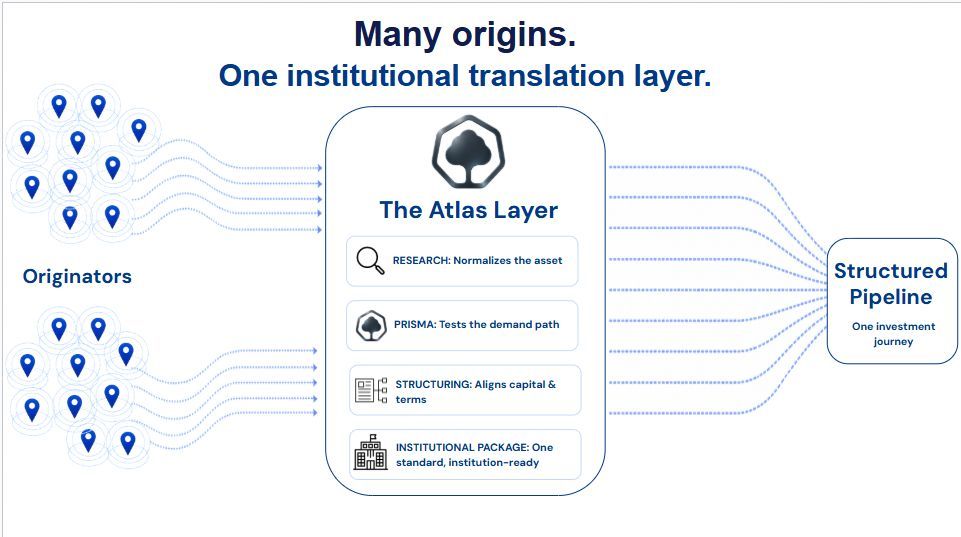
At the top of the funnel, Atlas is built as a distributed origination network: local relationships across Brazil, the U.S., and other markets feeding opportunities into one institutional translation layer. Scale comes from turning fragmented local signals into comparable opportunities while keeping origination local.
That map has to cover demand as well as supply. Atlas has to know, early, which buyers can actually take a given exposure, and what each of them needs to be changed before the deal is worth showing.
Some of those buyers are also sources of early signal. An advisor network can map demand and surface borrower need at the same time. Atlas treats advisor-referred deals as one more inflow into the funnel: useful when validated, dangerous when waved through because the relationship is warm.
The demand side of that map is Prisma: a live commercial record, queried deal by deal, updated after each round, and trusted by the teams deciding whether a transaction deserves more work. A CRM logs who has been contacted. Prisma logs what each buyer can take: in what wrapper, at what ticket, and what it has already turned down.
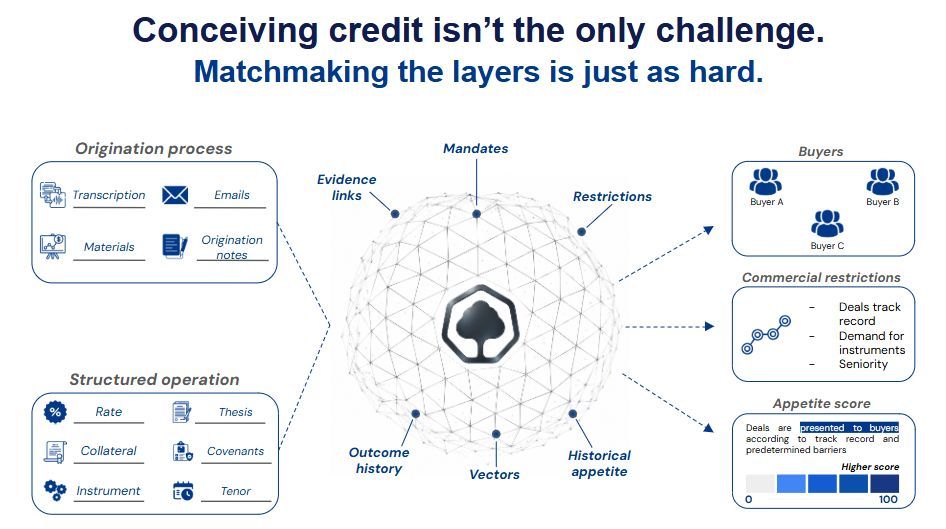
Prisma turns demand into operating judgment: who can buy, through which channel, under what structure, with what evidence, and what still needs to change before the deal should move.
Prisma is the demand layer of the Atlas Operating System. Research, the team that normalizes each asset, makes the deal readable; Prisma makes demand operational. One side normalizes the asset. The other compares that asset against the living memory of the market: which buyers have appetite, which pockets inside each mandate can hold it, and what each buyer has already said or done in similar situations. The practical benefit is pipeline discipline: Atlas approaches buyers with cleaner evidence and converts each decline into a constraint that improves the next match.
That matters because distribution knowledge decays fast when it lives only in calls, inboxes, meeting notes and individual memory. A buyer may like receivables but reject a specific servicer. It may accept a thesis only through a certain wrapper. It may have one pocket for duration and another for spread. It may say “send it” out of curiosity, with no real appetite behind it. The same record also has to capture when a buyer becomes a source: who referred the deal, what conflicts the referral creates, and whether the signal came from relationship proximity or from validated credit work. Prisma’s job is to turn those fragments into a usable commercial memory before the team spends structuring time on a deal with no natural buyer.
The unit of work is the Prisma of the deal. For each operation, Prisma answers five questions before broad distribution begins: who is the natural buyer, why that buyer fits, which evidence supports the claim, what blocks the approach, and what action comes next. The output is a decision, not a distribution list: prioritize now, rework the structure, clarify one missing point, or stop spending time.
Prisma also changes the role of Sales in the operating system. Sales takes ownership of demand intelligence: refreshing restrictions, recording outcomes, and feeding the next deal with sharper evidence. The more disciplined the loop, the less Atlas depends on memory and the more each commercial round improves the next one.
The risk is false precision. A ranking without evidence will not earn trust from Sales, Origination, Structuring or Committee. Prisma only compounds if the base is clean: traceable evidence, owner validation, freshness checks, and outcome feedback. Without that discipline, the system formalizes rumor. With it, Atlas builds an institutional demand graph that competitors cannot copy from a deck.
How This Works in Practice
Take a Brazilian lender with a receivables pool. Before asking “is the credit attractive?”, Atlas asks: “which institutional buyers can actually own this exposure, and what has to be true for them to approve it?”
That means testing whether the asset is what it claims to be, from data integrity and servicing capacity to enforceability and fraud risk. At the same time, investor appetite is tested against the buyer’s real constraints: mandate, ticket size, currency, tenor, and regulatory treatment.
If the gaps are real but solvable, the structure is adjusted before the deal is marketed broadly. After closing, servicing and performance data feeds back into future origination and investor targeting.
Now take a U.S. mid-market loan. Once the operation is normalized, with borrower, collateral, covenants, return, tenor, and open diligence items pinned down, Prisma tests the market path: which channel can absorb the exposure, in what wrapper, at what hurdle, with what evidence, and what has to be explained to the end client.
Or run it the other way. An advisor flags that a client’s company needs a receivables facility. Prisma records the referral source and the commercial context before the opportunity gets treated as real supply. Atlas still has to validate the asset, resolve compensation and allocation conflicts, test suitability and disclosure, and decide which channel can review the deal cleanly.
In both cases, Prisma surfaces the constraints before the market does. If the buyer needs a different ticket size, wrapper, concentration limit, servicing report, or structural mitigant, the team knows that before the deal is marketed.
Speed comes from running the steps in parallel, with the diligence bar unchanged: origination, normalization, Prisma demand testing, structuring, documentation and monitoring all inform one another as they run.
The product lowers the translation cost between local origination and institutional capital. Prisma is the system that makes that cost visible, comparable, and improvable over time.
Strategic Implication
Balance sheet size, fund size, and token interface matter less than early knowledge. The winning platform will know three things earlier than everyone else: where reliable supply is forming, which channels can surface or absorb it, and what each closed deal teaches the next origination cycle.
Put numbers on it: a receivables pool originated at roughly a 20% gross asset yield can reach the end client at roughly a 16% net yield. That four-percentage-point gap prices the work in between: finding the borrower, validating the asset, structuring the risk, matching it to the right buyer, clearing the channel, and keeping the position monitorable after close.
The workflow owner captures that spread before the allocator does. The largest pool of capital does not automatically win it. It goes to the party that shortens the path from signal to committed capital, deal by deal.
Prisma is how Atlas makes that workflow compound. The first deal creates a commercial read. The second tests it. The third improves the buyer profile, the pitch angle, and the structure. Over time, each closed transaction leaves a second asset behind: the demand graph Atlas built while trying to close it.
Atlas should be judged by a hard platform metric: how much time it removes between first asset signal and committed capital, without lowering the underwriting bar. Prisma should be judged by its contribution to that metric: how quickly and accurately it identifies the natural buyer, blocking constraints, required evidence, and next action for each deal.
Conclusion
For a decade, private credit was treated as a supply-and-demand story. Could the asset class raise enough capital? Could it find enough borrowers? Those questions have moved away from the center of the market. The product has matured, capital has formed, and demand has moved downstream.
The channel remains.
In cross-border credit, that channel has to pass three tests: legal enforceability, economic transfer, and operational control. In the U.S., the same problem often shows up at the advisor desk: can the exposure clear the product shelf, the platform, the fiduciary process, and the wrapper? Some of those same relationships can also surface borrower needs before they become broadly marketed deals. Different geography, same bottleneck: the asset has to become readable and ownable before capital can move.
The hard parts remain. Credit has to be enforceable, serviced well, supported by clean data, resilient through cycles, and free of unmanaged channel conflicts. The internal danger is equally clear: if origination scales faster than validation, the model creates more noise than capacity.
Atlas’s opportunity is to compress the path from local origination to committed, monitorable capital without turning diligence into a checkbox exercise. Prisma is the system that makes that compression possible: it turns buyer history, channel constraints, appetite evidence, and commercial outcomes into deal-level decisions before a transaction is fully structured or broadly marketed.
Done well, distribution becomes part of underwriting rather than a sales function.
Sources
J.P. Morgan Asset Management. Alternative Investments Outlook 2026 (8th Annual Edition). J.P. Morgan, 2025.
EY (Ernst & Young). Economic Contribution of Private Credit to the US Economy in 2024. EY, 2024.
Charles Schwab & Co. Modern Wealth Survey 2025. Charles Schwab, 2025.
Charles Schwab & Co. RIA Benchmarking Study 2025. Charles Schwab, 2025.
Cerulli Associates. U.S. Retail Advisor Metrics 2024. Cerulli Associates, 2024.
Kitces, Michael. “Trends in Financial Advice Fees: What Financial Advisors Are Actually Charging for Their Services.” kitces.com, June 16, 2025.
Kitces Research. The Kitces Report, Volume 2, 2024: How Financial Planners Actually Price Their Services. kitces.com, 2024.
Bank of America Private Bank. 2024 Study of Wealthy Americans. Bank of America, June 2024.
UBS. Global Wealth Report 2025. UBS, 2025.
AIMA & Alternative Credit Council. “Strong Growth Sees Private Credit Market Reach US$3.5 Trillion.” Press release.
Federal Reserve Board. Senior Loan Officer Opinion Survey on Bank Lending Practices. April 2023.
Federal Reserve Board. “Bank Lending to Private Credit: Size, Characteristics, and Financial Stability Implications.” FEDS Notes, May 23, 2025.
Reuters. “Global Securities Watchdog Says Tokenization Creates New Risks.” November 11, 2025.
Merrill Lynch (Bank of America). “The Great Wealth Transfer.”